| The Public Paperfolding History Project
Last updated 22/8/2025 x |
|||||||
| Quilling / Paper Filigree / Paperoles / Mosaicon | |||||||
| This
page is being used to collect information about the
history of the paperfolding technique known as Quilling
or Paper Filigree in which rolled and/or zigzag folded
strips of paper are glued onto flat sheets / surfaces of
wood / card etc in order to decorate them. Please contact
me if you know any of this information is incorrect or if
you have any other information that should be added.
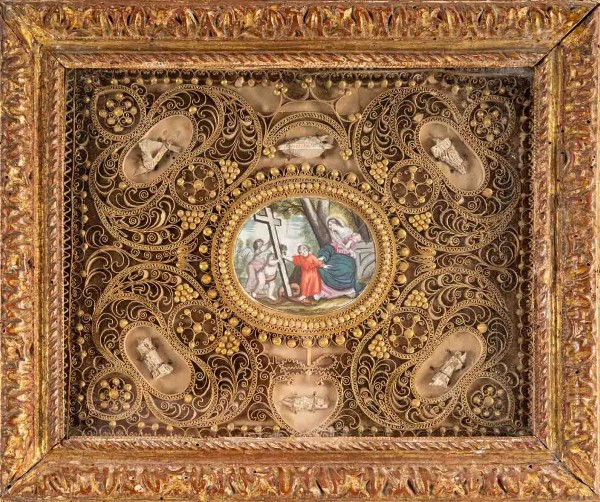
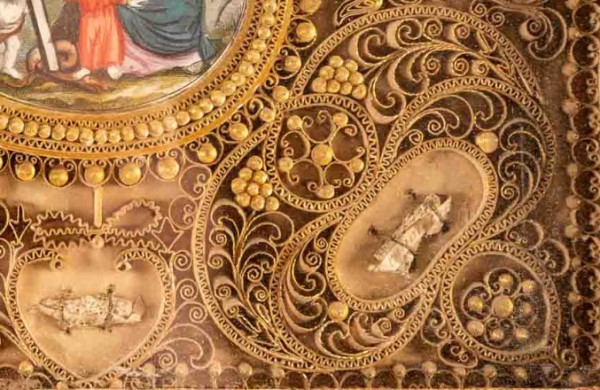
Thank you. ********** According to the article 'Quilling: Devotional Creations from Cloistered Orders' (see here ) which draws its information from 'Meraviglie di carta : devozioni creative dai monasteri di clausura' (Quilling : devotional creations from cloistered orders) by Bernard Berthod and Elena Geuna, published by Mantova c2012, which is the catalogue of an exhibition held at the Pinacoteca Giovanni e Marella Agnelli, Turin, in 2012: 'quilling reflected the spiritual climate of the Catholic Church following the Council of Trent, convened in 1545 by Pope Paul III'. 'Quilling channeled the Baroque tastes of that time period, the center of production being located in the Catholic Alps — Swabia and Bavaria, the Tyrol, Alto Adige and Trentino, and spreading out to Piedmont, eastern France, the Rhone Valley and Provence — and provided a historical record of a form of craftsmanship that was little known but widespread among the various female religious cloistered orders until the 20th century, especially the Sisters of the Annunciation, Poor Clares, Carmelites, Carthusians, Cistercians, Sacramentines, and Visitandines, but even some male monastic communities. The distinctive features of these artifacts — the time-consuming, labor-intensive craftsmanship involved, the idea of devotion to work as an act of prayer and the use of simple, “poor” materials — fittingly encapsulate the rules of these orders, picking up the old Benedictine adage: ora et labora (“pray and work”). Aesthetically speaking, the end result is comparable to the artistic value of these small masterpieces, yet because of their fragile materials they have remained so little known that they have never been studied or protected. They have always been regarded as mere bondieuseries and many have been destroyed.' It is not clear how such reliquaries are to be dated with any accuracy. ********** 1600 - 1699 This reliquary is said to date from the 17th century (see A 17th century Paperole Reliquary). The paper filigree elements are both rolled and zigzag folded. The small packets contain relics of the saints.
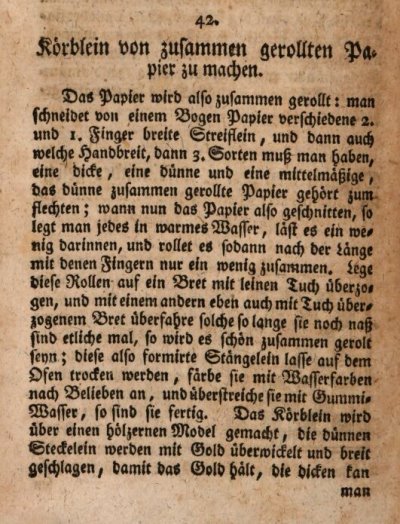
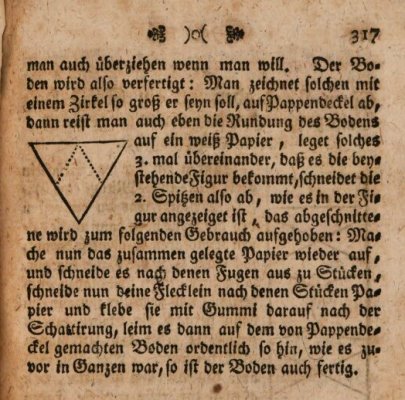
********** 1762 Part Five of 'Die Zehenmal Hundert und Eine Kunst' by Albrecht Ernst Friedrich von Crailsheim, which was published in 1762, contains a section titled (in translation) 'How to Make Baskets out of Rolled Paper' which seems to me to be a description of how to make a tetrahedral basket decorated by the Quilling /Paper Filigree technique.
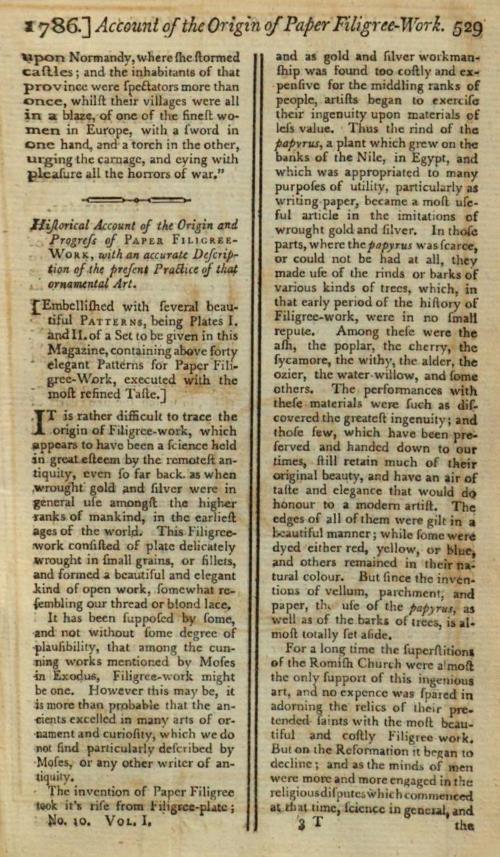
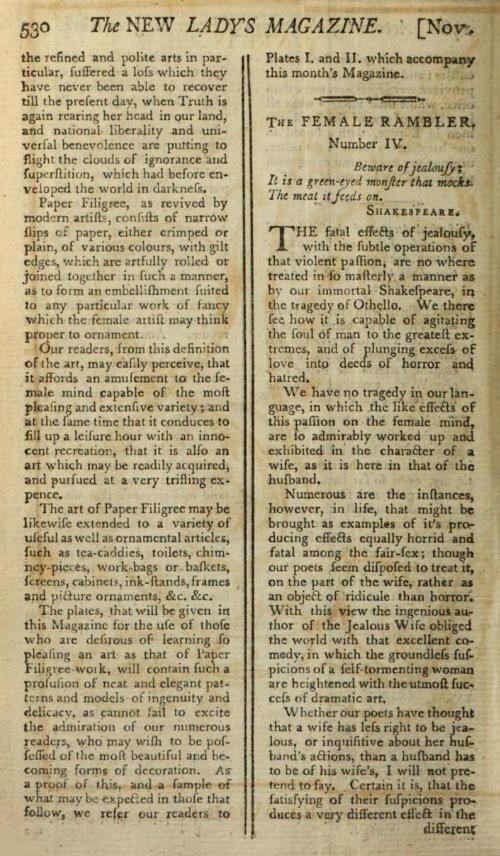
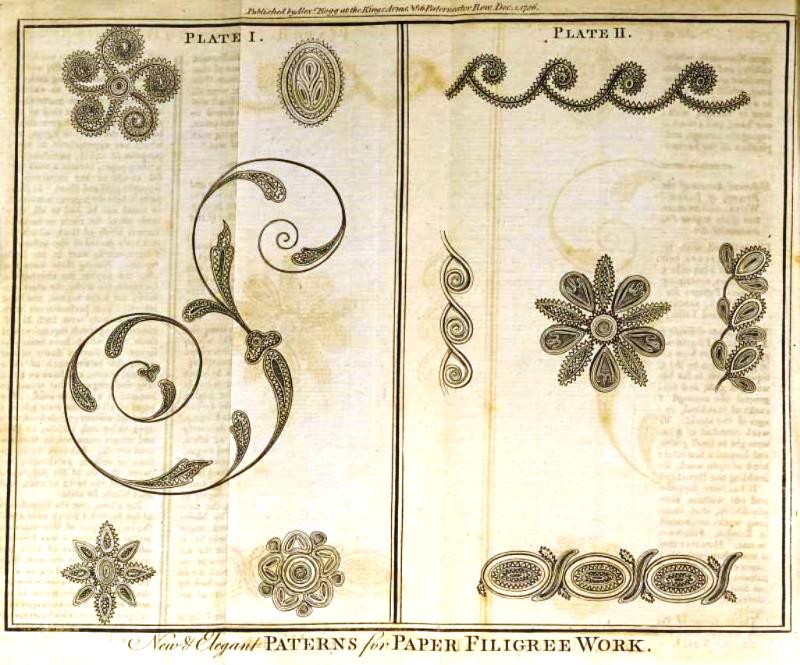
********** 1786 The July 1786 issue of 'The New Lady's Magazine' contained a review of a book of Paper Filigree patterns. The November 1786 issue contained a history of the art and two plates of patterns. It is worth noting that the patterns make more use of folds than contemporary quilling designs do.
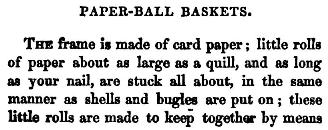
********** 1811 The making of a paper filigree basket features in Jane Austen's novel 'Sense and Sensibility', first published, anonymously, in 1811. "I am glad," said Lady Middleton to Lucy, "you are not going to finish poor little Annamaria's basket this evening; for I am sure it must hurt your eyes to work filigree by candlelight. And we will make the dear little love some amends for her disappointment to-morrow, and then I hope she will not much mind it." This hint was enough, Lucy recollected herself instantly and replied, "Indeed you are very much mistaken, Lady Middleton; I am only waiting to know whether you can make your party without me, or I should have been at my filigree already. I would not disappoint the little angel for all the world: and if you want me at the card-table now, I am resolved to finish the basket after supper." "You are very good, I hope it won't hurt your eyes—will you ring the bell for some working candles? My poor little girl would be sadly disappointed, I know, if the basket was not finished tomorrow, for though I told her it certainly would not, I am sure she depends upon having it done." Lucy directly drew her work table near her and reseated herself with an alacrity and cheerfulness which seemed to infer that she could taste no greater delight than in making a filigree basket for a spoilt child. And: "Perhaps," continued Elinor, "if I should happen to cut out, I may be of some use to Miss Lucy Steele, in rolling her papers for her; and there is so much still to be done to the basket, that it must be impossible I think for her labour singly, to finish it this evening. I should like the work exceedingly, if she would allow me a share in it." ********** 1833 'The Girl's Own Book' by Lydia Marie Child, which was published by Clark Austin and Co in New York in 1833, contains a section titled 'Paper-Ball Baskets' which describes the technique of quilling.
********** 1875 'Mosaicon' by William Bemrose was published by Bemeose and Sons in Derby in 1875. As well as instructions for qulling patterns this book contains a catalogue of 'Foundations' intended to be decorated by the quilling technique. ********** 1876 'The Art Journal' of 1876 contains an interesting review of William Bemrose's 'Mosaicon' which suggests that the technique had largely been forgotten since 'our grandmothers time.' ********** 1887 A paragraph about 'Paper Ball Baskets' appears in 'The Home Book for Very Little People' by J H Vincent, which was published by Phillips and Hunt in New York in 1887.
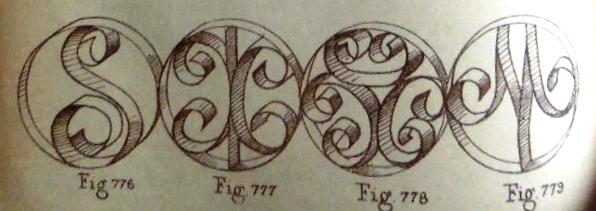
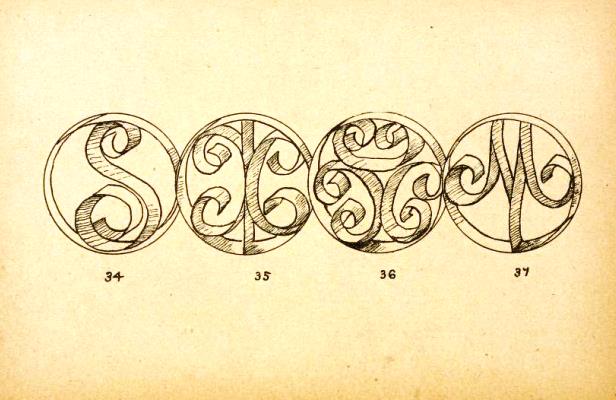
********** 1890 'Exercises Methodiques de Travaux Manuels' by Jean Boogaerts, which was published in Belgium and France in 1890, contains illustrations of free-standing 'roundels' that can be made using the quilling technique.
********** 1898 Conversation and Coleridge, with other essays' by Thomas de Quincey was published postumously by William Heinemann in London in 1898. It contains a passage referring to 'very ingenious imitations of objects cut out in paper filigree'.
********** 1900 The roundels explained in Boogaerts (see above) also appear in 'Construction Work in Cardboard and Paper' by Robert M Smith, which was published by A Flanagan Co in Chicago in 1900.
********** |
|||||||