| The Public Paperfolding History Project
Created 30/9/2026. Last updated 30/9/2026 x |
|||||||
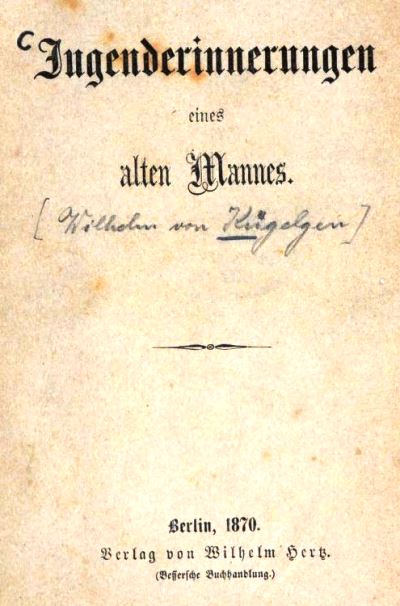
| Jugenderinnerungen eines altes Mannes by Wilhelm von Kügelgen, 1870 | |||||||
| 'Jugenderinnerungen
eines altes Mannes' (Childhood Memories of an Old Man) by
Wilhelm von Kügelgen (1802-1867) was published by
Wilhelm Herz Verlag Berlin in 1870. In it the author
describes how, in about 1812, when the family were living
in Dresden, in Saxony, his then tutor, the painter Carl
Adolf Senff (1785-1863), taught him, together with his
siblings Gerhard and Adelheid, and the Leipzig friends
Alfred and Julius Volksmann, to fold Krahen (crows). It
is clear from the description that these were Cocotte /
Pajaritas. The children learned to add further folds to
develop these crows into cavalry and infantry (horses and
riders), some of which still survive in museums in
Germany. The invention of the horses and riders is
attributed to Senff himself. It is not known where Senff might have learned to fold Cocottes. He grew up in Halle, also in Saxony, and as far as is known had no personal connection with France where the design is first evidenced some ten years earlier. Some sources state that he had a French governess, but this is untrue. A full copy of the work can be found online here. **********
**********
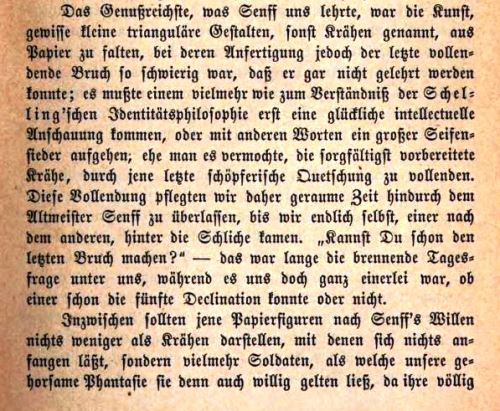
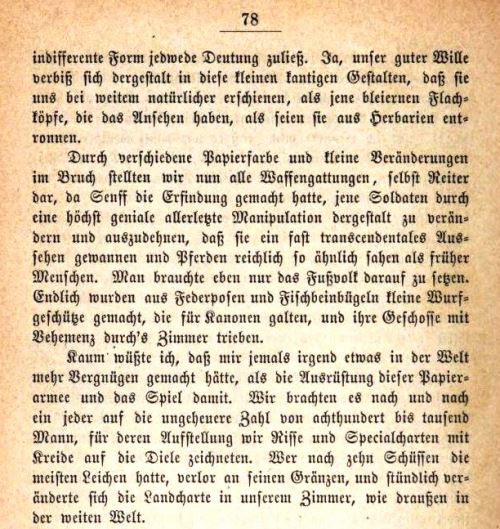
In English, roughly, translated: 'The most enjoyable thing that Senff taught us was the art of folding certain small triangular shapes, otherwise called crows, out of paper. Howewver, the last fold was so difficult to make that it couldn't be taught at all. Rather one had to experience a fortunate intellectual insight, or in other words, a great shift in logic, before one could complete the most carefully prepared crow with that final creative compression. For quite some time, thereforew, we left this to the old master Senff, until we finally figured it out for ourselves, one after the other. 'Can you make the final fold?' was the burning questrion among us for a long time, while it was completely irrelevant whether someone could do the fifth declension or not.' 'Meanwhile, according to Senff's wishes, these paper figures were not to represent crows, which are useless, but rather soldiers, which is what our obedient imagination readily accepted them to be, since their completely indifferent form allowed for any interpretation. Indeed our good will became so fixated on these small, angular figures that they appeared far more natural to us than those leaden flatheads that look as if they have escaped from herbaria.' 'By using different coloured paper and making small changes to the fold, we were now able to represent all branches of the armed forces, even cavalry, since Senff had invented a highly ingenious manipulation to alter and enlarge those soldiers in such a way that they acquired an almost transcendental appearance and looked remarkably like horses, much like the people had previously. One simply had to place the infantry on them. ...' 'I scarcely know of anything in the world that gave me more pleasure than equipping this paper army and playing with it. We each gradually built it up to the enormous number of 800 to 1000 men, for whose deployment we drew maps and special charts with chalk on the floorboards. Whoever had the most dead bodies after ten shots lost at the limit, and the map in our room changed hourly, just like out in the wide world.'. ********** |
|||||||