| The Public Paperfolding History Project
Last updated 5/3/2026 x |
|||||||
| Paperfolding in Education in France 1852 onwards | |||||||
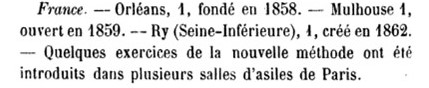
This page is being used to collect information about the history of paperfolding in France after the death of Froebel in 1852. Please contact me if you know any of this information is incorrect or if you have any other information that should be added. Thank you. ********** 1855/7 The Baroness von Marenholtz spent most of 1855/7 in France. She gave many lectures in Paris and appears to have succeeded in interesting several existing institutions in adopting at least part of the Froebelian method, akthough the lack of trained teachers appears to have prevented the opening of kindergartens per se. According to 'Manuel Theorique de la Reform Educative de Frederic Froebel' by Edward Raoux, the kindergartens open in France by 1862 were:
********** 1873 ********** 1882 On 27th July 1882 the French government minister, Jules Ferry, issued a decree regulating the pedagogical organisation and the study plan of public primary schools (Arrêté du 27 juillet 1882 réglant l’organisation pédagogique et le plan d’études des écoles primaires publiques) which made it mandatory for French primary schools (for children aged 7 to 14) to include manual work (activities designed to aid the development of manual skills, which would then be useful in an industrial and economic context) in their curricula. There is no specific mention of paperfolding in this decree (although it does mention cardboard modelling /cartonnage).However, many primary schools did subsequently began to include paperfolding as part of their manual training syllabus. A second decree issued a day later (Arrete reglant l'organisation pedagogique des maternelles publique et les programmes d'enseignement) set out the methods to be followed in infants school (ecoles maternelles) and a curriculum to follow. This curriculum did specifically mention ‘pliage’ (paperfolding) under the 'exercises manual' (manual exercises) section. This, of course, led to publication of articles about suitable paperfolds to be incorporated in lessons in magazines and books. The use of paperfolding in schools must also, surely, have acted to increase the recreational use of paperfolding as children’s play. ********** 1883 The first article that I know of published about the use of paperfolding in ecoles maternelles, and specifically in the infants class, appeared in the 'Journal des Instituteurs' of 7th January 1883. It mentions 'objects made of paper: boats, bowls, hats, saltcellars, cocottes, envelopes etc. The number is quite limited' and 'The folding of two strips of paper of different colours, serpents or accordions as children call them, which we have all made under the instruction of out grandmothers'. It also complains that 'there is however still an obstacle: coloured paper is relatively dear; the best quality costs 25 centimes for 100 bands: It is 25 centimes per day, for fifty children, and many of our 'ecoles maternelles' are unable to afford this for their infant classes ...' The cost of materials was clearly a limiting factor in the use of paperfolding in such schools at this time. ********** 1887 'Cours de Travail Manuel (Pour les Garcons)' by A Planty, 1887 ********** 'Enseignement du Travail Manuel a L'Ecole Primaire' by Emile Faivre, 1887 ********** ********** Les travaux manuels a l'ecole primaire by Dauzat and Deramond, 1890 ********** 1891 3rd January 1891 - Arrete fixant le programme d'enseignement de travail manuel dans les ecoles normales d'instituteurs provided for the first year of teacher training to include tuition in 'Weaving, folding, cutting and cardboard work related to the teaching of drawing, geometric shapes, and arithmetic' as well as 'Binding and boxing a book'. There also appears to have been a decree dated 3rd June 1891 setting out a curriculum for schools which included the same requirements, but I have not as yet been abler to locate a copy. ********** 'Bulletin de la Société de Protection des Apprentis', 1891 The 'Bulletin de la Société de Protection des Apprentis', an official document issued by the Société de Protection des Apprentis et des Enfants Employes par les Manufactures in Paris in 1891, sets out educational syllabuses for apprentices which make use of paperfolding. They include, among other folds, the Waterbomb, the Patisserie Box and ‘La Grenouille Japonaise’ (otherwise known as the Inflatable Frog). ********** 1894 The Preface of the Third Revised Edition of 'Cours Normal de Travail Manuel' by P Martin was published by Armand Colin et ces Editeurs in Paris in 1894 states, inter alia: 'it seems that the period of trial and error, through which all new things pass, is over with regard to manual education. It has been recognised that it is neither possible nor desirable for all elementary schools to be equipped with a workshop for iron and wood. In 1891 a commission established to prepare a curriculum for teaching manual work in the primary schools of Paris clearly distinguished between schools without workshops and schools equipped with one. It developed for the former a complete program in which the handling of paper, cardboard, wire etc gives rise to a sufficient number of educational exercises, with a progression easily established ... ' and '... a decree of the Minister of Public Instruction dated January 3rd 1891 ... modified the programs of normal schools ...' accordingly. A copy of this decree was included at the end of the Preface (and is reproduced below). It provides for the first year of teaching to include: 'Weaving, folding, cutting and cardboard work related to the teaching of drawing, geometric shapes, and arithmetic' as well as 'Binding and boxing a book'. ********** 1895 L'Enseignement Manuel by Rene Leblanc, 1895 ******** Geometrie, Dessin et Travaux Manuels - Cours Elementaire - M E. Cazes, 1895 ********** Geometrie, Dessin et Travaux Manuels - Cours Moyen - M E. Cazes, 1895 ********** |
|||||||